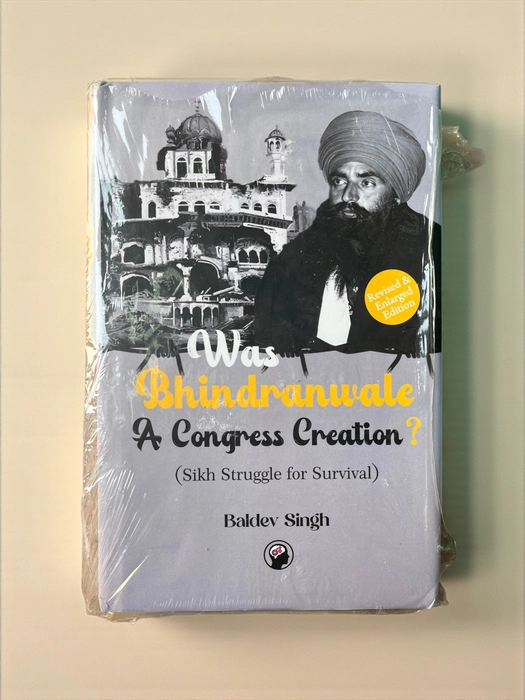
Was Bhindranuale A Cangress Creation ( Sikh Struggle For Survival ) - Baldev Singh
Product details
⭐ English Summary
Author: Baldev Singh Theme: A critical examination of whether Jarnail Singh Bhindranwale was created or used by the Indian National Congress, along with an analysis of the Sikh struggle during the 1970–1984 period.
🔷 1. Central Question of the Book
The book investigates the highly debated question:
“Was Bhindranwale a creation of the Congress?”
The author explores political, historical, and documentary evidence rather than relying on rumors.
🔷 2. Political Background (1970s–1980s Punjab)
Baldev Singh explains the tense political environment in Punjab:
Heavy rivalry between Congress and the Akali Dal
Central government’s desire to weaken Akali influence
Deep dissatisfaction among Sikhs regarding broken promises
Rising religious tensions (such as the 1978 Nirankari–Sikh clash)
Increasing interference of Delhi in Sikh religious affairs
This background helps explain how a strong religious leader could naturally emerge.
🔷 3. Bhindranwale’s True Personality
The author paints Bhindranwale as:
A strict follower of Sikh Rehat Maryada
A social reformer who opposed drugs, alcohol, and injustice
A preacher who rose from within the masses
A voice against Sikh persecution and discrimination
A leader who openly challenged corruption in politics
According to the author, his popularity grew organically, not artificially.
🔷 4. Did Congress Promote Him?
Arguments suggesting early Congress support:
Congress wanted to divide the Akali vote-bank.
Some Congress politicians felt the Damdami Taksal’s influence could counter Akalis.
In the very early stage, Bhindranwale was not seen as a threat to the government.
Author’s Conclusion: “Not Creation, but Miscalculation.”
Baldev Singh concludes:
Bhindranwale was NOT a Congress creation.
Congress leadership misjudged his influence and misread Sikh sentiments.
When Bhindranwale gained spiritual and political strength, he turned strongly against the government policies.
Instead of weakening the Akalis, he became a symbol of Sikh resistance.
🔷 5. Broader Sikh Struggle
The book expands the discussion beyond Bhindranwale:
Sikh identity under threat
Repeated betrayals by the central government
Attacks on Punjabi language, culture, waters, and federal rights
Media’s biased portrayal of Sikhs in the 1980s
Mass arrests, torture, fake encounters, and violations of Sikh dignity
The buildup to Operation Bluestar and its consequences
The author frames the period as a struggle for Sikh survival, not just a political conflict.
🔷 6. Final Conclusion
Baldev Singh’s final argument:
Bhindranwale was not a political puppet created by any party.
He emerged from genuine Sikh grievances, discrimination, and pain.
Congress’s early attempts to play political games backfired.
Bhindranwale ultimately became a grassroots religious symbol and the face of Sikh defiance.
The real cause of the crisis was the systemic injustice faced by Sikhs, not the rise of one leader.
⭐ Short Summary
This book argues that Bhindranwale was not a creation of the Congress. He rose from within the Sikh community due to widespread anger, injustice, and broken promises. Political actors may have underestimated him, but they did not control him. The Sikh struggle, as the book shows, was fundamentally a fight for identity, rights, and survival.